
“`html
The Critical Need for Accuracy: Why a Health News Checklist is Essential
In an era defined by the rapid-fire delivery of information, health news has become one of the most consumed—and most misunderstood—genres of digital content. From breakthrough cancer treatments to the latest “superfood” trends, the public is bombarded with headlines that promise life-altering results. However, the stakes in health reporting are uniquely high. Misinformation in this field doesn’t just result in a misunderstanding of facts; it can lead to dangerous medical decisions, unnecessary anxiety, and a breakdown of trust in scientific institutions.
For journalists, content creators, and savvy readers, navigating this landscape requires a rigorous framework. This is where a proven checklist for health news becomes indispensable. By applying a standardized set of criteria to every medical claim, we can separate high-quality, evidence-based reporting from sensationalized clickbait. This guide outlines the essential components of that checklist to ensure journalistic integrity and public safety.
1. Identify the Source: Primary Research vs. Press Releases
The first step in any health news evaluation is identifying where the information originated. Many viral health stories are based on university press releases rather than the actual study. While press releases are helpful summaries, they are designed to generate publicity and may omit critical limitations.
- Locate the original study: Always look for a link to the peer-reviewed journal article. If the news report doesn’t cite the source, proceed with extreme caution.
- Check the journal’s reputation: Not all journals are created equal. High-impact journals (like The Lancet, JAMA, or NEJM) have rigorous peer-review processes, whereas predatory journals may publish anything for a fee.
- Differentiate between expert opinion and data: A quote from a doctor is valuable context, but it is not the same as a statistically significant finding from a controlled trial.
2. Analyze the Study Design: The Evidence Pyramid
Not all scientific evidence carries the same weight. A fundamental part of the health news checklist is determining where the study sits on the “Evidence Pyramid.” A common mistake in health reporting is treating an animal study as if it applies directly to humans.
Human Trials vs. Animal/Cell Studies
If a headline claims a “Cure for Diabetes Found,” but the study was conducted on mice, the headline is misleading. Many physiological processes in animals do not translate to human biology. A reliable health report will clearly state the subjects of the study in the first few paragraphs.
Observational vs. Experimental Studies
Observational studies find correlations (e.g., people who drink coffee live longer), but they cannot prove causation. Randomized Controlled Trials (RCTs) are the gold standard because they involve a control group and an experimental group, allowing researchers to isolate the effects of a specific intervention.
3. The “Power” of the Numbers: Sample Size and Duration
A study’s validity often hinges on its scale. A health news story based on a study of ten people is anecdotal at best. To be statistically significant, a study generally needs a large, diverse sample size that reflects the broader population.
- Sample Size (n): Larger groups reduce the margin of error. If “n” is small, the results might just be a coincidence.
- Study Duration: Chronic conditions like heart disease or Alzheimer’s develop over decades. A six-week study claiming a supplement prevents dementia is logically flawed; the timeframe is too short to observe long-term outcomes.
4. Relative Risk vs. Absolute Risk: Decoding the Percentages
One of the most frequent ways health news sensationalizes data is through “relative risk.” You might see a headline stating, “Eating Processed Meat Increases Cancer Risk by 20%!” While technically true, this number is often misleading without the context of “absolute risk.”

If the absolute risk of a certain cancer is 5 in 100, and a 20% increase occurs, the new risk is 6 in 100. The risk only increased by 1 percentage point. Reporting only the 20% figure makes the danger seem far more dramatic than it is. A high-quality health news report will always provide both figures to give readers a realistic perspective.
5. Check for Conflicts of Interest and Funding
Transparency is the backbone of ethical health reporting. When evaluating a news story, it is vital to ask: Who paid for this research? While industry-funded research isn’t automatically false, it does introduce a potential for bias.
For example, a study on the health benefits of chocolate funded by a major confectionery corporation should be scrutinized more closely than one funded by an independent government body like the NIH (National Institutes of Health). Journalists should always disclose funding sources and potential conflicts of interest held by the researchers or the institutions involved.
6. Contextualize the Findings: Is it “First of its Kind”?
Science is a slow, cumulative process of building on previous work. It rarely moves in “giant leaps.” Any health news story that claims to be a “miracle,” “breakthrough,” or “first of its kind” should be viewed with skepticism.
- Does it fit the existing body of evidence? If a new study contradicts decades of established science, it requires extraordinary proof.
- Has it been replicated? A single study is never a definitive answer. Scientific truth is established through replication—when other scientists repeat the experiment and get the same results.
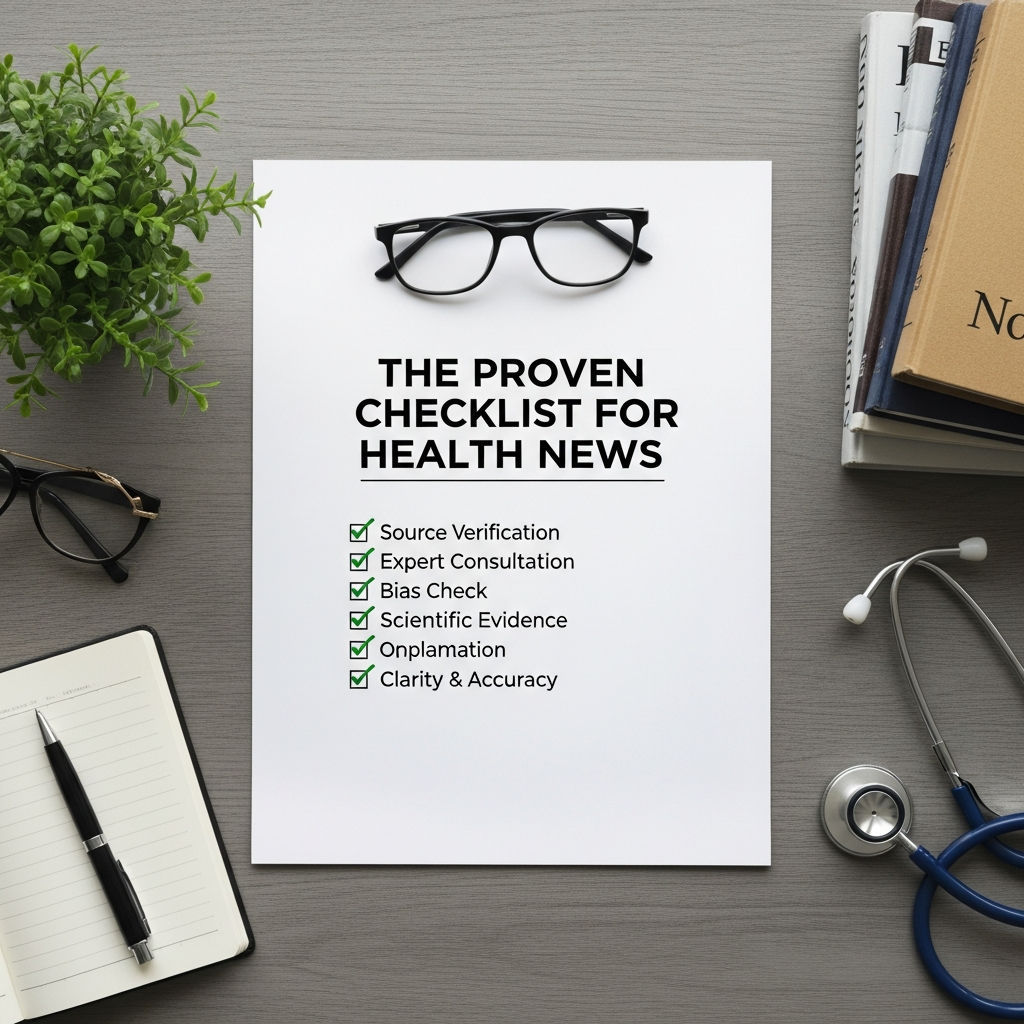
7. The Ultimate 10-Point Checklist for Health News Quality
Before publishing or sharing a health-related article, run it through this quick-reference checklist:
- Peer Review: Was the study published in a reputable, peer-reviewed journal?
- Subject Type: Was the research conducted on humans, animals, or in a lab dish?
- Causation: Does the article claim “A causes B” when the study only shows a “link” or “association”?
- Absolute Risk: Are the actual numbers provided, or just scary-sounding percentages?
- Sample Size: Was the study large enough to be statistically meaningful?
- Control Group: Was there a placebo or control group for comparison?
- Funding: Is the funding source disclosed and potentially biased?
- Clinical Significance: Does the result actually matter for a patient’s health, or is it just a tiny shift in a lab marker?
- Expert Balance: Does the story include comments from independent experts not involved in the study?
- Limitations: Does the article mention what the study *didn’t* prove or who it *doesn’t* apply to?
Conclusion: Empowering the Public Through Better Reporting
The “infodemic” is a real threat to public health, but it can be mitigated through rigorous standards. By following a proven checklist for health news, we shift the focus from viral engagement to factual accuracy. For writers, this builds long-term authority and SEO trust (E-E-A-T). For readers, it provides the tools necessary to filter out the noise and make informed decisions about their well-being.
In the world of medical science, the truth is rarely found in a sensational headline; it is found in the nuances, the limitations, and the careful verification of data. Use this checklist as your shield against misinformation and your guide to responsible health communication.
“`