How to Master Health News in 36 Days: A Comprehensive Guide to Health Literacy
In an era where information travels at the speed of light, staying informed about your health has never been easier—or more confusing. From viral TikTok wellness trends to sensationalized headlines about “miracle cures,” the landscape of health news is a minefield of misinformation. Developing “health literacy” is no longer just a luxury; it is a vital life skill.
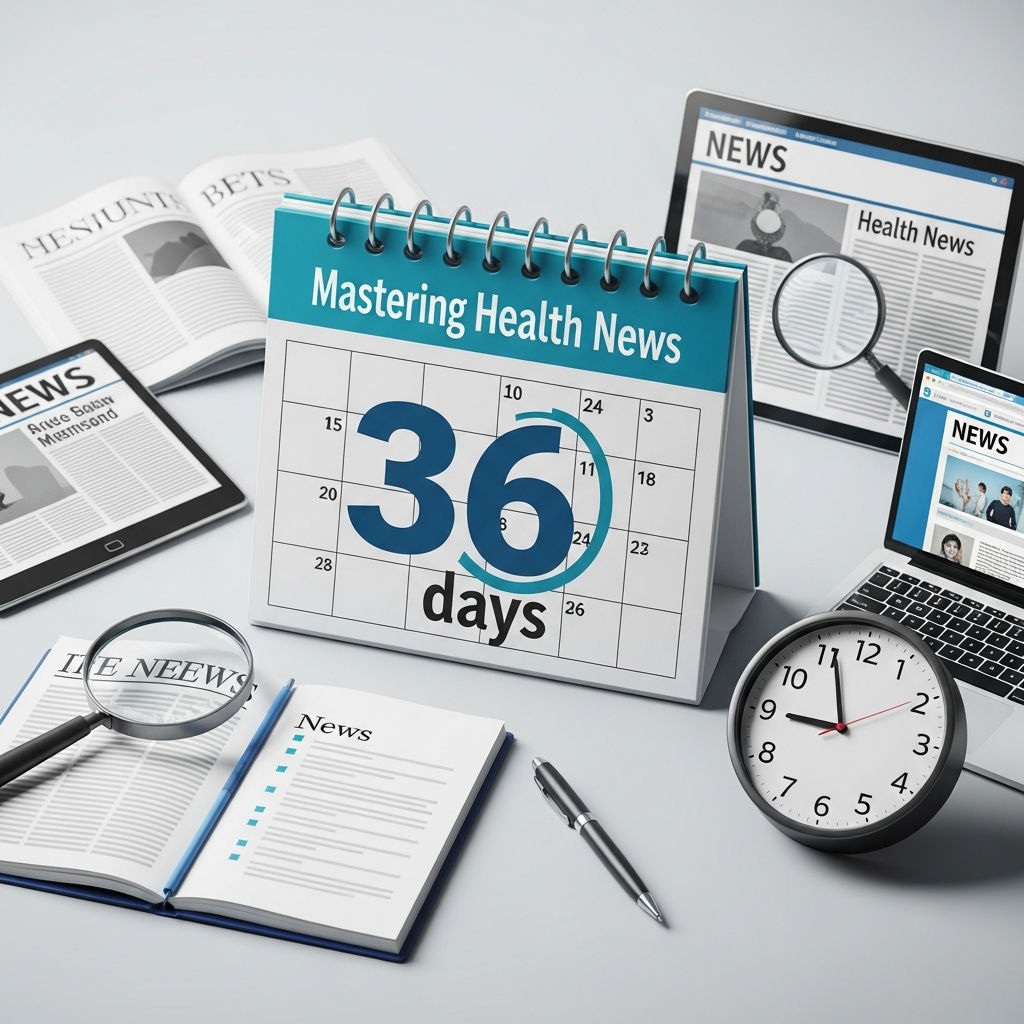
But how do you transform from a confused reader into a savvy health news expert? It doesn’t happen overnight, but it can happen in just over a month. This guide outlines a 36-day roadmap to help you master health news, decode medical jargon, and make evidence-based decisions for your well-being.
Phase 1: Building the Foundation (Days 1–7)
The first week is about auditing your current intake and identifying where reliable information actually lives. Mastering health news begins with understanding the difference between “news” and “noise.”
Day 1–3: Audit Your Feed
Start by looking at where you get your health information. Are you relying on Instagram influencers, morning talk shows, or generic news sites? For the first three days, unfollow accounts that make “absolute” claims (e.g., “This one fruit cures cancer”) and bookmark primary sources.
Day 4–7: Identify Tier-1 Sources
To master health news, you must go to the source. Spend the remainder of the week familiarizing yourself with these three pillars:
- Government Agencies: The CDC (Centers for Disease Control and Prevention), NIH (National Institutes of Health), and the NHS (National Health Service) provide vetted, evidence-based data.
- Peer-Reviewed Journals: Familiarize yourself with names like The Lancet, The New England Journal of Medicine (NEJM), and JAMA.
- Academic Institutions: Health blogs from Harvard, Mayo Clinic, and Johns Hopkins are excellent bridges between complex science and public understanding.
Phase 2: Decoding the Language of Science (Days 8–14)
You cannot master health news if you don’t speak the language. Medical reporting often uses specific terms that, if misunderstood, can lead to false conclusions.
Day 8–10: Correlation vs. Causation
This is the most common trap in health reporting. Just because two things happen at the same time doesn’t mean one caused the other. For example, a study might find that people who drink coffee live longer. That is a correlation. It doesn’t necessarily mean coffee caused the longevity; it might be that coffee drinkers also happen to have higher incomes or better healthcare access.
Day 11–14: Understanding Study Types
Not all studies are created equal. Use these days to learn the “Hierarchy of Evidence”:
- Meta-Analysis/Systematic Reviews: The gold standard. They look at all available research on a topic to find a consensus.
- Randomized Controlled Trials (RCTs): The best way to test if a treatment actually works.
- Observational Studies: Good for finding patterns, but cannot prove cause and effect.
- Animal/In-Vitro Studies: Interesting, but rarely translate directly to human health. If a headline says “Cure for Diabetes Found,” but the study was done on mice, it’s not ready for human application.
Phase 3: Developing a Critical Filter (Days 15–21)
Now that you know where to look and how to read, it’s time to learn how to smell a “marketing ploy” disguised as news.
Day 15–17: The “Who Benefits?” Test
Every time you read a health story, ask: Who funded this? A study claiming dark chocolate improves heart health might be funded by a major candy manufacturer. While the data might not be “fake,” the way it is presented often favors the sponsor. Mastering health news requires checking the “Conflicts of Interest” section at the bottom of a study.
Day 18–21: Spotting Sensationalism and Clickbait
Health journalists often use “scare tactics” or “miracle language” to get clicks. Beware of words like:
- Breakthrough
- Secret
- Miracle
- Instant
- Toxic (when used vaguely)
If a headline sounds too good (or too scary) to be true, it likely is. True medical progress is usually slow, incremental, and boring.
Phase 4: Deep Diving into Specialized Topics (Days 22–28)
Health news isn’t a monolith. Different rules apply to nutrition, mental health, and longevity science.
Day 22–24: The Nutrition Trap
Nutrition is the most “noisy” sector of health news. This is because it is incredibly hard to track what people eat over 20 years. When reading nutrition news, look for “longitudinal studies” with large sample sizes, and be wary of “elimination” diets that claim to solve every ailment.
Day 25–28: Mental Health and Neuro-Hype
With the rise of “biohacking,” news about brain health is everywhere. Learn to distinguish between “wellness advice” (like meditation) and “medical claims” (like a supplement that claims to cure ADHD). Mastery here involves understanding that the brain is complex, and “one-size-fits-all” solutions rarely work.
Phase 5: Application and Synthesis (Days 29–36)
In the final stretch, you move from being a consumer to a practitioner of health literacy.
Day 29–32: Practice Fact-Checking
Find a trending health story on social media. Use your Tier-1 sources to verify it. Can you find the original study? Was the sample size large enough? Did the news outlet exaggerate the findings? Doing this manually for four days will solidify your “crap detector.”
Day 33–35: How to Talk to Your Doctor
The goal of mastering health news isn’t to replace your doctor; it’s to partner with them. Use these days to learn how to bring news to your physician. Instead of saying, “I read that I should take this,” try: “I saw a recent study in The Lancet about this treatment; do you think it applies to my specific health profile?”
Day 36: Establish Your Routine
On the final day, set up a sustainable system. Subscribe to one or two high-quality health newsletters (like the New York Times Well section or the Stat News Morning Rounds). Set aside 15 minutes a week to catch up on reputable summaries rather than scrolling through social media daily.
Conclusion: The Lifelong Benefit of Health Literacy
By the end of these 36 days, you will have developed a specialized lens through which to view the world. Mastering health news isn’t about knowing every medical fact—it’s about knowing how to evaluate the information presented to you. In a world where your health is often used as a commodity for clicks, being an informed consumer is the ultimate form of self-care.
Remember, science is a process, not a destination. New data will emerge, and old “truths” will be debunked. But with the framework you’ve built over the last 36 days, you’ll be ready to navigate those changes with confidence, skepticism, and clarity.